

What Happens to Debt When You Die? Does Your Family Pay?
When someone you love dies, the letters do not stop. Within weeks there can be credit card statements, loan reminders and sometimes a debt collector, all addressed to a person who is no longer here. It is frightening, and it usually lands on you at the worst possible time.
Here is what happens to debt when you die in England and Wales, in plain terms; In most cases, debt does not pass to the family. Debts are paid from what the person left behind (their estate). If the estate cannot cover them, most of what is left unpaid is written off. There are some exceptions, and they are explained below, together with what to do if you are the executor.
This guide is for families and executors in England and Wales.
The key points:
• You do not inherit a parent's or partner's debts. The estate pays them.
• You may still owe a debt if you were a joint borrower or a guarantor, or if it is a household bill for a home you shared.
• An additional cardholder on someone else's credit card does not have to repay the balance.
• If there is nothing in the estate, debts in the person's sole name usually die with them.
• Executors must not pay out to the family until the debts are known, or they can end up paying from their own pocket.
In this guide
• What happens to debt when you die?
• Can you inherit debt in the UK?
• Credit cards, loans and mortgages: which debts does the estate pay?
• Am I responsible for my husband's or wife's debts?
• Do I have to pay mum's or dad's debts?
• Does debt die with you if there is nothing in the estate?
• Letters and debt collectors: what to do
• What is not part of the estate?
• Tax, benefits, student loans and council tax
• If you are the executor: paying the debts in the right order
What happens to debt when you die?
When you die, your debts are paid from your estate: the money, property and belongings you leave behind. Your family does not have to pay them from their own money. Whatever the estate cannot cover is usually written off, unless someone else was a joint borrower or a guarantor.
The person dealing with the estate (the executor if there is a will, or the administrator if there is not) pays the debts before anyone inherits. As Citizens Advice puts it, you are not automatically liable for the debts of someone who has died, even if you were their husband, wife or civil partner.
Can you inherit debt in the UK?
No. You cannot inherit someone's debt in the UK. What you inherit is whatever is left after the debts have been paid. That can mean a smaller inheritance, or none, but it does not mean a bill.
There are four situations where you can still end up paying:
• You were a joint borrower. A joint loan, joint credit card account or joint mortgage is your debt too. The lender can ask you for the full amount, not just half.
• You were a guarantor. If you signed a personal guarantee for their loan or tenancy, the guarantee still stands.
• You shared the home. If you lived with the person, you may still be liable for bills that relate to the property, such as council tax or water, according to Citizens Advice.
• You are the executor and paid out too soon. An executor who gives money to the family before the debts are settled can be made to pay them personally. See the executor section below.
Credit cards, loans and mortgages: which debts does the estate pay?
Credit card debt, personal loans and overdrafts in the person's sole name are paid from the estate. If the estate cannot pay them in full, the rest is usually written off. What changes the answer is whether the debt was joint, secured on property such as a house, or guaranteed by someone else:
| Type of debt | Examples | Who pays after the death |
|---|---|---|
| In the person's sole name, unsecured | Credit cards, personal loans, overdrafts, store cards, utility bills | The estate. If there is not enough, the rest is usually written off. |
| Joint | Joint loan, joint credit account, joint mortgage | The surviving borrower, for the full amount. With joint borrowing this will usually mean the outstanding balance can be pursued from the survivor |
| Secured | Mortgage, secured loan | The lender has a claim on the property itself and is paid from it first. |
| Guaranteed | A loan or tenancy someone guaranteed | The estate, and the guarantor can also be asked to pay under the guarantee. |
Sources: MoneyHelper on debts after a death and Citizens Advice on whether you have to pay a debt.
Am I responsible for my husband's or wife's debts?
Being married or in a civil partnership does not, on its own, make you responsible for your partner's debts. Their credit cards and loans in their sole name are paid from their estate, not by you. However, you may still be personally liable where the debt is also in your name
Joint debts are different. If you both signed for a loan, an overdraft on a joint account or a mortgage, the lender can ask you to repay all of it. With a joint mortgage, MoneyHelper explains that the surviving owner carries on making the repayments as normal. It is worth checking straight away whether there was life insurance or mortgage protection that pays off the loan on death.
If the mortgage was in your partner's sole name, it is paid from the estate. Our guide to property during probate explains what happens to the house meanwhile.
What if I was an additional cardholder on their credit card?
Then you do not have to pay the balance. Citizens Advice confirms that a credit card company cannot ask an authorised additional cardholder to repay the debts on the card.
An additional cardholder is someone the account holder allowed to use their card, which is not the same as a joint account. Stop using the card once the account holder has died.
Do I have to pay mum's or dad's debts?
No, not from your own money, unless you were a joint borrower or a guarantor. Your parent's debts are paid from their estate, and anything the estate cannot pay is usually written off.
If you are the executor, your job is to pay them from the estate, in the right order, before anything is shared out. That is a job, not a personal debt. It can feel wrong to leave a bill unpaid, but you do not need to make up the difference.
Does debt die with you if there is nothing in the estate?
Yes, usually. Debt does not die straight away: it is paid from the estate first. But if there is nothing in the estate, debts in the person's sole name usually die with them, and the lender cannot pass them on to the family. MoneyHelper says that where no estate is left, the debts will usually be written off. This is known as an insolvent estate.
Where there is some money but not enough to pay everyone, the estate is insolvent, and the debts are paid in a strict legal order (see the executor section below).
Letters and debt collectors: what to do
Letters often keep arriving for months. They are upsetting, but most of them can be dealt with in a few simple steps:
• Tell each lender in writing that the person has died, and give the name and contact details of the executor or administrator. From then on, the lender should deal with them.
• If you are not liable, say so. If you were not a joint borrower or guarantor, write back to say that you are not responsible for the debt and pass the letter to the executor. Do not agree to pay anything from your own money.
• Stop the marketing post. The Bereavement Register and the Deceased Preference Service are free services that take the person's name off mailing lists. They do not stop bills or bank statements.
• Tell the government once. The Tell Us Once service tells HMRC, the Department for Work and Pensions and other public bodies in one go.

Lenders and debt collectors regulated by the Financial Conduct Authority must follow its rules on collecting debts. Under those rules they:
• must not misrepresent their legal position on a debt
• must not share details of a debt with someone before checking that they are the borrower or acting for them
• must not put customers under unfair pressure to pay
A collector may tell you that you must pay a debt you are not liable for. If so, ask them to put the legal basis in writing, and send it to the executor.
If the letters are adding to worries about your own finances, free, confidential help is available from MoneyHelper, National Debtline and StepChange.
What is not part of the estate?
Some money and property passes straight to another person when someone dies. It does not usually form part of the estate, so it is not counted when the estate's debts are worked out.
• Life insurance paid to a named person or held in trust. MoneyHelper explains that in most cases the payout goes directly to the nominated beneficiary. If no one was nominated, it may fall into the estate and be used for debts.
• A home owned as joint tenants. Joint tenants own the whole property together, so when one dies, their share passes automatically to the other owner and is not part of the estate. Tenants in common each own a separate share, which they can leave by will, so that share is part of the estate and can be used to pay debts.
• Most workplace and private pension death benefits. These are usually paid at the discretion of the scheme to the people the member nominated, rather than through the estate.
Tax, benefits, student loans and council tax
• Council tax: any council tax owed up to the death is a debt of the estate. If the home is left empty, GOV.UK explains that no council tax is due until probate is granted, and a further exemption of up to 6 months may follow. Anyone who still lives there may have to pay.
• Tax owed to HMRC: GOV.UK lists unpaid personal taxes among the debts the executor pays from the estate.
• Benefit overpayments: the Department for Work and Pensions can recover them from the estate. It writes to the executor once probate has been granted.
• Student loans: a student loan can be cancelled once the Student Loans Company receives the death certificate.
If you are the executor: paying the debts in the right order
If you are the executor or administrator (the personal representative), you are responsible for paying the debts from the estate before anything goes to the family. GOV.UK is clear that if you share out the estate without keeping enough back for the debts and taxes, you may have to pay them yourself. That risk can be avoided.
Do not pay anyone until you know what is owed
Start by going through the person's post and paperwork and writing to every lender you know of. The standard protection against debts you do not know about is a Section 27 notice.
A Section 27 notice is a deceased estates notice placed in The Gazette, the official public record, asking creditors to come forward within at least two months. It takes its name from section 27 of the Trustee Act 1925.
Once the two months have passed, you can share out the estate taking account only of the claims you know about. You are then not personally liable to a creditor who did not respond. If the estate includes land, the notice should also go in a local newspaper where the land is. The protection covers you, but a late creditor can still try to recover money from the people who inherited it.
There is no need to rush: an executor is not bound to distribute the estate before one year from the death.
When the estate cannot pay everything
An estate is insolvent when its debts, and the costs of dealing with it, are more than everything the person left. You must then pay the debts in the order set by the Administration of Insolvent Estates of Deceased Persons Order 1986.
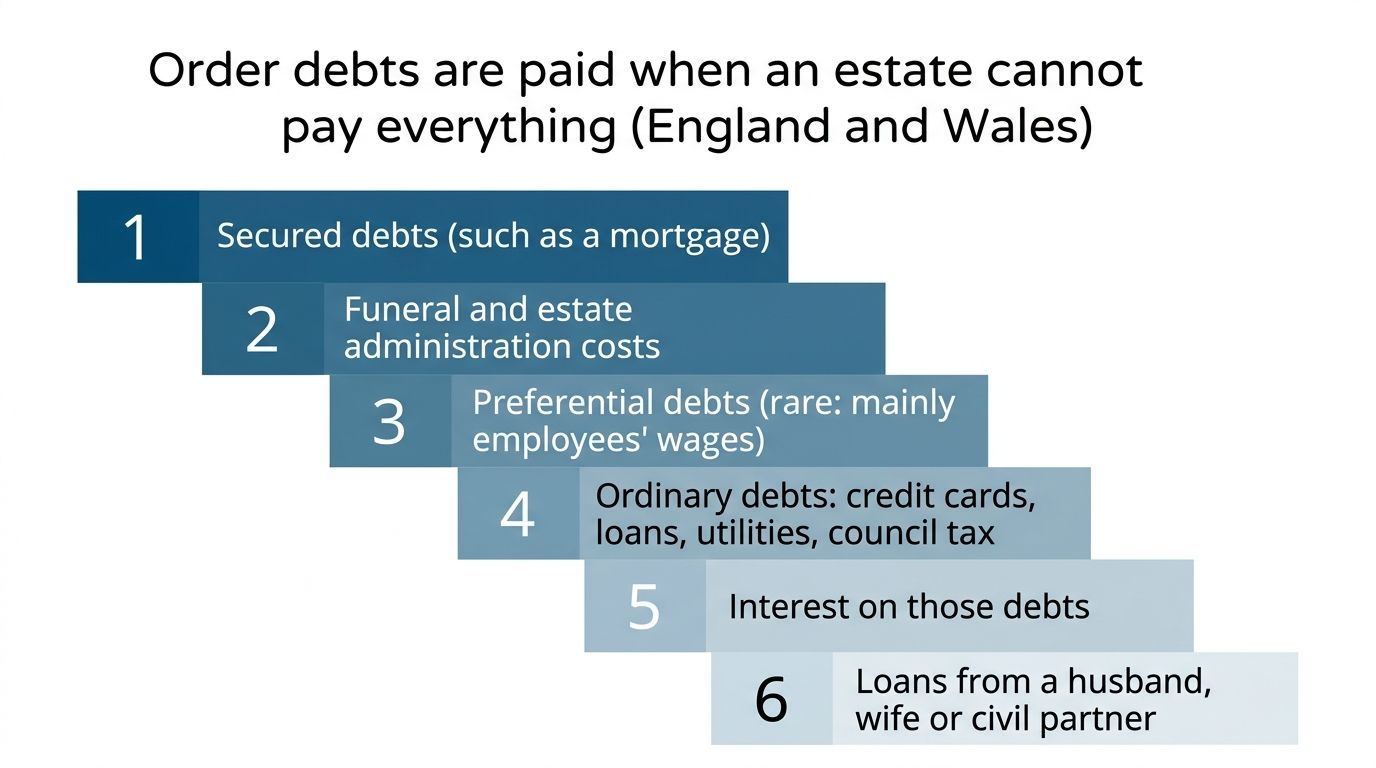
In short, debts in an insolvent estate in England and Wales are paid in this order: secured debts, then funeral and administration costs, then preferential debts, then ordinary debts, then interest, then loans from a spouse or civil partner. You must not pay one ordinary creditor in full while others get nothing. In more detail:
1. Secured debts, such as a mortgage, which are paid from the property they are secured on.
2. Reasonable funeral, testamentary and administration expenses: the funeral, and the costs of dealing with the estate.
3. Preferential debts. For most people there are none. They mainly arise if the person employed someone, for example unpaid wages and pension contributions. They also include VAT, and tax such as PAYE that a business owner had deducted from others and owed to HMRC. Schedule 6 to the Insolvency Act 1986 lists them.
4. Ordinary unsecured debts, shared out in proportion. This includes credit cards, personal loans, overdrafts, utility bills, council tax and the person's own income tax.
5. Interest on those debts, if anything is left.
6. Money lent by the person's husband, wife or civil partner, which comes last.
Some online guides, including Google's own summaries, list utility bills and council tax as "priority debts" to pay first. In an insolvent estate, they are not. They rank alongside the other ordinary debts. If you have already paid some creditors and then discover the estate is insolvent, take advice before paying anyone else.
In some cases a creditor, or the executor, can ask the court to take over an insolvent estate through an insolvency administration order, and a trustee then deals with it.
Can I refuse to deal with an estate full of debt?
Often, yes. An executor named in a will can refuse the role (renounce) using form PA15, but only if they have not already started acting in the estate. Acting in the estate is known as intermeddling. The form asks you to declare that you have not intermeddled in the estate.
According to The Gazette, tasks such as telling a bank about the death can count as intermeddling, but arranging the funeral does not. If you are unsure whether something you have done counts, take advice before signing anything.
Where there is no will, close family are entitled to apply to deal with the estate in the order set by the probate rules (for Letters of Administration). Being entitled to apply does not, by itself, make a relative the administrator or make them personally liable for the deceased's debts. If the people with prior entitlement are cleared off and no one with a beneficial interest takes the grant, a creditor can in some circumstances apply for administration instead. Our guide to the intestacy rules explains who is entitled to deal with an estate when there is no will.
Walking away is not the only option. Many executors carry on with help, so the debts are paid in the right order. Our guide to being an executor explains the wider role, and our contentious probate page covers what can be done if a co-executor starts paying people without agreement.
Frequently asked questions
Do next of kin inherit debt in the UK?
No. Being next of kin does not make you responsible for someone's debts. You only owe a debt if it was in your name as well, you guaranteed it, or it is a household bill for a home you shared.
What debts are not written off when someone dies?
Joint debts, which pass in full to the surviving borrower. Guaranteed debts, which the guarantor may have to pay. Secured debts such as a mortgage, which the lender recovers from the property. And any debt the estate has enough money to pay.
Can a creditor chase the family for payment?
It can ask the executor to pay from the estate, but it cannot make a relative pay a debt that is not in their name. If the estate was shared out before the debts were paid, the creditor may claim against the executor or the people who inherited.
Do debts have to be paid before probate?
Not usually. If the estate needs probate, most debts are paid once the executor has it, because that is when they can collect in the money. Some small estates do not need probate at all. Either way, GOV.UK advises paying the debts and taxes before sharing anything out.
Funeral costs are often paid earlier, because many banks will pay the funeral director directly from the person's account. Our guide to how long probate takes explains the timescales.
Does this apply in Scotland or Northern Ireland?
No. This guide covers England and Wales only. Scotland and Northern Ireland have their own rules for dealing with debts after a death.
Talk it through with us
So, to the question most families start with: you do not inherit a loved one's debts. The estate pays what it can, and the rest is usually written off. Only joint borrowers, guarantors and executors need to take care.
This guide is general information about the law in England and Wales. It is not advice on your family's situation, which will always depend on the facts.
Are you an executor facing debts that look larger than the estate, or unsure what to pay first? We can help you work out where you stand. Call us on 0208 515 2790 for a free, no-obligation 20-minute chat, or send us an enquiry. You can also read about our probate and estate administration service.
If this has made you think about your own affairs, an up-to-date will and life cover written in trust can make things much simpler for your family.

Author Bio:
Nasreen Akhter is the founding director of Ash Hill Solicitors and a private client solicitor with over a decade of experience in probate, wills, estate planning and elderly client care. Known for her calm, compassionate approach, she guides individuals and families through life's most sensitive legal matters with clarity and care.
Nasreen is also an accredited civil and commercial mediator, and is listed on the Solicitors Regulation Authority (SRA) register. Outside of work, she's a dedicated mum and chairs Happy Orphans Worldwide, a charity supporting vulnerable children worldwide.