

Power of Attorney and Dementia: Is It Too Late to Get One?
Watching a parent change in front of you is one of the hardest things a family goes through. Many people describe it as grieving someone who is still here. The person you know is slipping away, and yet there are bills to pay, forms to sign and decisions nobody has made.
If your mum or dad has been diagnosed with dementia, the question that usually follows is whether it is too late to put a power of attorney in place. Often it is not. A diagnosis on its own does not mean someone has lost the ability to make their own decisions. This guide explains how to tell, what to do while there is still time, and what happens if that time has passed.
This guide is for families of someone with dementia in England and Wales. The key points:
• A dementia diagnosis does not automatically mean it is too late for a Lasting Power of Attorney.
• What matters is whether your parent understands the LPA at the moment they make it, even if they have bad days.
• If your parent has capacity and refuses, that is their right.
• If it is too late, the route is deputyship through the Court of Protection, or a DWP appointee where the only income is benefits.
• Being next of kin gives no automatic legal authority over a parent's money or care.
In this guide
• Is it too late for power of attorney once someone has dementia?
• What does mental capacity actually mean?
• Good days and bad days: when capacity comes and goes
• What if mum or dad can no longer sign their name?
• What if your parent refuses to make one?
• Which power of attorney does your parent need?
• Does the next of kin have the right to decide anyway?
• If it is too late and there is no power of attorney: deputyship
• LPA, deputyship or appointee: how they compare
• Can someone with dementia still make or change a will?
• If your parent already has an LPA or an old enduring power of attorney
• What if you are worried about how an attorney is acting?
• Looking after yourself as well
Is it too late for power of attorney once someone has dementia?
Not necessarily. You can still get a power of attorney for someone with dementia, but only if they make it themselves while they have the mental capacity to do so. If they can no longer have mental capacity, it is too late for a Lasting Power of Attorney (LPA), and the family would need to apply for deputyship instead.
Understanding means knowing what the document is, who they are appointing and what those people will be able to do, at the moment they sign. Deputyship is granted by the Court of Protection, the court that makes decisions for people who lack capacity.
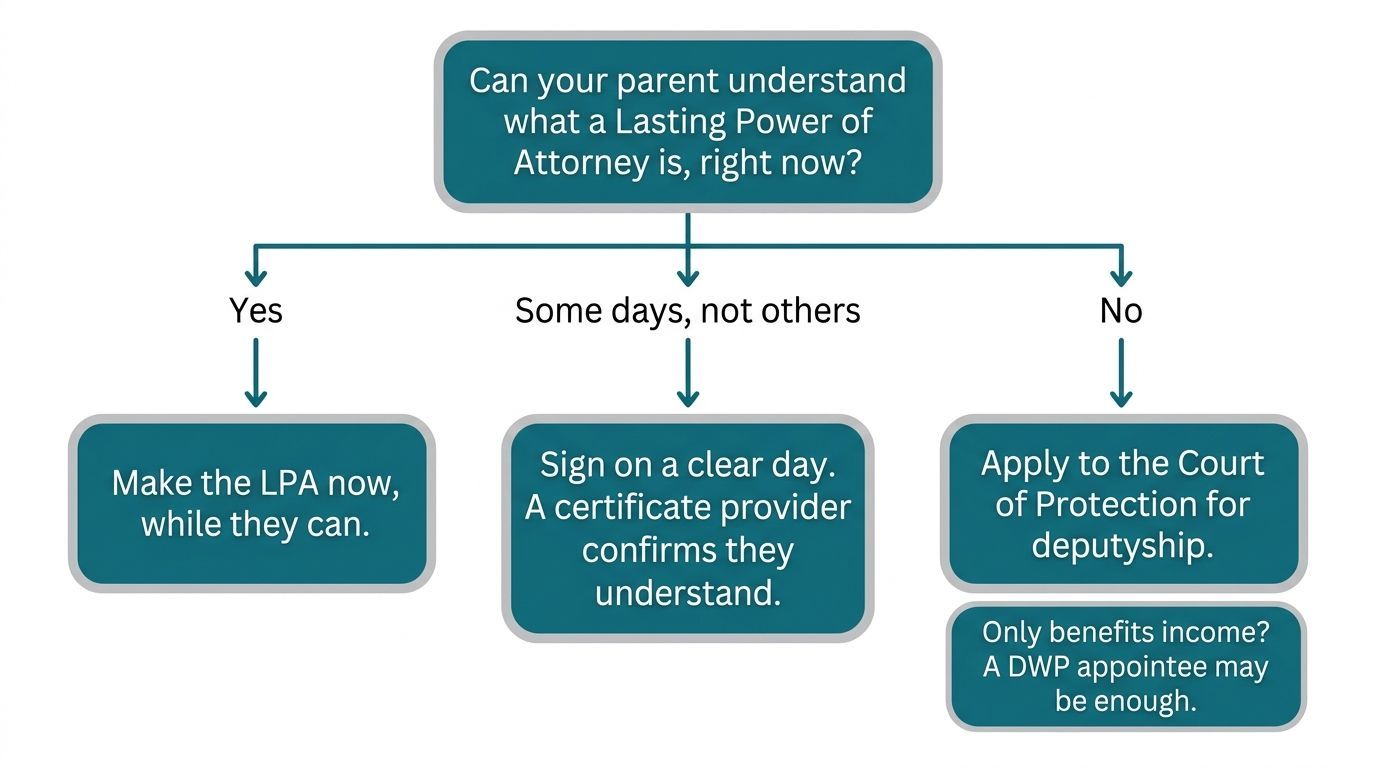
In practice, families usually find themselves in one of three places:
• They can still decide. Make the LPA now, while they can.
• They have good days and bad days. An LPA may still be possible if it is made on a clear day. See fluctuating capacity below.
• They can no longer decide. The route is deputyship through the Court of Protection.
What does mental capacity actually mean?
A dementia diagnosis does not, on its own, mean someone lacks the mental capacity to make a Lasting Power of Attorney. Mental capacity is the ability to make a particular decision at the time it needs to be made, and the law assumes a person has it unless it is shown that they do not.
The test is set by the Mental Capacity Act 2005, which applies in England and Wales.
That assumption surprises most families, and so does the second point: capacity is about one decision at one time. Your dad might no longer manage his pension, but still be perfectly able to decide who he trusts to help him with it.
Under section 3 of the Act, someone is unable to make a decision if they cannot do any one of these four things:
• understand the information relevant to the decision
• retain that information long enough to make the decision
• use or weigh up that information as part of deciding
• communicate their decision, by any means
That is why a dementia diagnosis alone does not settle the question. Many people in the earlier stages of dementia can still meet this test for an LPA.
Good days and bad days: when capacity comes and goes
Fluctuating capacity means a person can make a decision at some times but not at others. It is common with dementia: your mum might be sharp on a Tuesday morning and confused by the evening.
It does not rule out an LPA. What matters is whether she has capacity at the moment she makes it. The Mental Capacity Act Code of Practice encourages choosing a time of day, and a place, when the person is at their best.
Every LPA also needs a certificate provider. This is an independent person who signs to confirm that the person making the LPA understands what they are doing and is not being pressured into it. Where there is real doubt, some families ask the GP or another professional for a view on capacity before the forms are signed, which gives everyone more confidence later.
What if mum or dad can no longer sign their name?
Being physically unable to sign is not the same as lacking capacity. Someone with arthritis, a tremor or poor eyesight may understand the LPA completely and simply be unable to hold a pen.
The LPA process allows for this. The person can make a mark, or someone else can sign on their behalf, in their presence and at their direction, with witnesses. Two witnesses are required where someone signs on behalf of a donor who cannot sign or make a mark; Continuation Sheet 3 is used; and this cannot presently be completed using digital signatures.
What if your parent refuses to make one?
This is more common than people expect. Some parents feel an LPA means handing over control, or that their children are being bossy. It can be painful to hear, especially when you can see what is coming.
The honest position is this: if your parent has capacity and says no, that is their decision, and nobody can make an LPA for them. What often helps is explaining that an LPA keeps the choice with them. They pick who acts for them, they can set limits, and a property and financial affairs LPA can be set up so that it is only used if they lose capacity.
If they later lose capacity without having made one, the family is not stuck. It means the longer route of deputyship, which is explained below.

Which power of attorney does your parent need?
A Lasting Power of Attorney is a legal document that allows a person to appoint one or more people, known as attorneys, to make certain decisions on their behalf. It only works in England and Wales, and it has to be registered before it can be used.
There are two types of LPA, and many people make both:
• Property and financial affairs. Paying bills, managing bank accounts and pensions, and selling the home if that becomes necessary. It can be used as soon as it is registered, with your parent's permission, or only once they lose capacity.
• Health and welfare. Decisions about daily care, medical treatment and where they live, including a move into a care home. It can only be used once they can no longer make those decisions themselves.
The health and welfare LPA is the one families often wish they had made. Without it, decisions about care are taken by the professionals involved, in what they judge to be the person's best interests, after consulting the family. With it, the attorney can make those decisions in their place, in their best interests.
An LPA cannot be used until it has been registered with the Office of the Public Guardian, the government body that registers powers of attorney and supervises deputies. Registration takes 8 to 10 weeks, according to GOV.UK if there are no mistakes in the application. That is another reason not to wait. Our guide to what a lasting power of attorney is explains the forms and choices in more detail.
Does the next of kin have the right to decide anyway?
No. Being next of kin, a husband or wife, or the eldest child gives you no automatic legal authority over someone else's money or care in England and Wales. It is one of the most common misunderstandings in this area. As GOV.UK sets out, the only ways to get that authority are for the person to appoint you while they have capacity, or for a court to appoint you.
Without an LPA or a court order, a bank will not usually let you run your parent's account, however close you are. While your parent still has capacity, some banks offer a third party mandate, which lets someone else operate the account on their instructions. It stops working if they lose capacity, so it is a stopgap rather than a substitute for an LPA.
If it is too late and there is no power of attorney: deputyship
If someone with dementia has lost capacity and has no power of attorney, nobody can sign an LPA for them. A family member or another suitable person has to apply to the Court of Protection to become their deputy: someone the court appoints to make decisions for a person who can no longer make them.
The court is based in London and deals with applications from across England and Wales. A property and financial affairs deputy manages money and property. A personal welfare deputy, which the court appoints less often, deals with care decisions. Usually, personal welfare applications are decided on hearings.
The application needs evidence of your parent's capacity and notice to certain people, and it takes longer and costs more than an LPA would have. Once appointed, a deputy is supervised by the Office of the Public Guardian. Our deputyship application guide walks through each step.
If your parent's only income is benefits
Where someone's income is their State Pension or other benefits and there are no savings or property to manage, a deputyship may not be needed for that money. The Department for Work and Pensions can appoint a family member as an appointee, to claim the benefits and spend them in your parent's best interests. GOV.UK explains how to become an appointee. It covers benefits only, not bank accounts, savings or property.
LPA, deputyship or appointee: how they compare
| Lasting Power of Attorney | Deputyship | DWP appointee | |
|---|---|---|---|
| Who sets it up | Your parent, while they have capacity | The Court of Protection appoints a deputy | The Department for Work and Pensions appoints an appointee |
| When it is possible | Only while your parent can understand what they are signing | Once your parent has lost capacity and there is no LPA | When your parent cannot manage their own benefits |
| Who chooses the person acting | Your parent | The court | The DWP, after an application |
| What it covers | Money and property, health and welfare, or both | Usually money and property; welfare deputies only in some cases | Benefits only |
| Who oversees it | Registered with the Office of the Public Guardian, which can investigate concerns | Supervised by the Office of the Public Guardian | The DWP |
Sources: GOV.UK guidance on lasting power of attorney, becoming a deputy and becoming an appointee.
Can someone with dementia still make or change a will?
Often, yes. The test for making a will is separate from the test for an LPA. Broadly, the person needs to understand that they are making a will and what it does. They need a general idea of what they own and who might expect to benefit. And their choices must not be driven by an illness of the mind that distorts those judgements. This comes from a long-standing court case, Banks v Goodfellow, and is known as testamentary capacity.
Where dementia is involved, it is good practice for a doctor to assess and record the person's capacity at the time the will is made. That record can matter a great deal if anyone questions the will later.
An attorney cannot make or change a will for the person. If your parent has already lost capacity, the Court of Protection can authorise a will on their behalf, known as a statutory will.
If a will was changed after the diagnosis
Sometimes families only find out after a death that a will was changed late in life, perhaps leaving everything to a new partner, a carer or one sibling. If you believe the person did not have capacity at the time, or was pressured into it, the will can be challenged. These disputes depend heavily on evidence and some steps are time-sensitive, so it is worth getting advice early. Our contested probate page explains how these claims work.
If your parent already has an LPA or an old enduring power of attorney
If your parent made an LPA some years ago, check whether it was registered. An unregistered LPA can still be registered while the person who made it is alive, but it cannot be used until registration is complete.
Enduring powers of attorney (EPAs) were made before 1 October 2007. An EPA can be used without registration while the person still has capacity. Once they are losing it, the attorney must register it with the Office of the Public Guardian. Our guide to an attorney's duties and responsibilities covers what acting as an attorney involves day to day.
What if you are worried about how an attorney is acting?
Disagreements over a parent's money are sadly common, especially when one sibling is the attorney and the others feel shut out. An attorney must act in your parent's best interests, keep their money separate from their own, and keep records.
If you think an attorney is misusing their position, anyone can report a concern to the Office of the Public Guardian, which can investigate where the person lacks capacity. In serious cases, the Court of Protection can remove an attorney.
Client story:
We acted for a family where three siblings had been appointed as attorneys for their mother, and one of them was not acting in her best interests. That attorney was interfering with her day-to-day care, including the food her carers provided, her sleep routine and the heating in her home. We applied to the Court of Protection to remove that attorney, and the court made her daughter the sole attorney. Her care has since settled, and she is comfortable and enjoying an active social life. It shows why the choice of attorneys matters, and that the law can step in when an attorney gets it wrong.
Looking after yourself as well
Grieving someone who is still alive is real, and it is exhausting. You may feel guilty for being frustrated, or for feeling relief when a decision is finally made. Those feelings are normal, and they are not a sign that you are doing this badly.
Sorting out the legal side will not take any of that away, but it does remove one layer of worry. For support with the emotional and practical side of caring, Dementia UK and the Alzheimer's Society are good places to start.
Frequently asked questions
Who is legally responsible for a person with dementia?
Nobody automatically. While the person has capacity, they make their own decisions. After that, legal authority sits only with an attorney under a registered LPA or EPA, or a deputy appointed by the Court of Protection. Even then, it only goes as far as that document or court order allows.
What decisions can an attorney not make?
An attorney cannot make or change a will for the person, consent to a marriage or divorce on their behalf, or vote for them. A health and welfare attorney can only refuse life-sustaining treatment if the LPA expressly gives them that power.
Can my mum with dementia give me money?
If she has capacity to make that particular gift, yes. It is her money and her choice. Once an attorney is managing her affairs, the rules are much tighter. Under section 12 of the Mental Capacity Act, attorneys can only make gifts on customary occasions, such as birthdays or religious festivals. The gifts must also be reasonable for the size of her estate. Anything larger needs the approval of the Court of Protection.
Can someone with dementia cancel or change their LPA?
Yes, if they have capacity to do so at the time. Cancelling (revoking) an LPA needs the same kind of understanding as making one.
How long does it take to register an LPA?
GOV.UK currently says 8 to 10 weeks if there are no mistakes in the application. Mistakes on the forms are a common cause of delay, so it is worth checking them carefully before they are sent.
Does this apply in Scotland or Northern Ireland?
No. This guide covers England and Wales only. Scotland and Northern Ireland have their own systems for powers of attorney and for decisions on behalf of someone who lacks capacity.
Talk it through with us
So, to the question most families start with: a dementia diagnosis does not, on its own, mean it is too late. If your parent can still understand what an LPA does, they can usually still make one. If they cannot, deputyship is the way forward, and your family is not stuck.
This guide is general information about the law in England and Wales. It is not advice on your family's situation, which will always depend on the facts.
Not sure whether an LPA is still possible, or worried it may already be too late? We can help you work out where you stand and what to do next. Call us on 0208 515 2790 for a free, no-obligation 20-minute chat, or send us an enquiry.
You can also read how we support older clients and their families on our elderly client care page, or about our lasting power of attorney service.

Author Bio:
Nasreen Akhter is the founding director of Ash Hill Solicitors and a private client solicitor with over a decade of experience in probate, wills, estate planning and elderly client care. Known for her calm, compassionate approach, she guides individuals and families through life's most sensitive legal matters with clarity and care.
Nasreen is also an accredited civil and commercial mediator, and is listed on the Solicitors Regulation Authority (SRA) register. Outside of work, she's a dedicated mum and chairs Happy Orphans Worldwide, a charity supporting vulnerable children worldwide.