
Bank Accounts After Death: Can Next of Kin Withdraw Money?
When someone close to you dies, the money questions arrive at the worst possible time. The funeral needs paying and the bank has stopped the account. You may not even know whether next of kin can withdraw money from it.
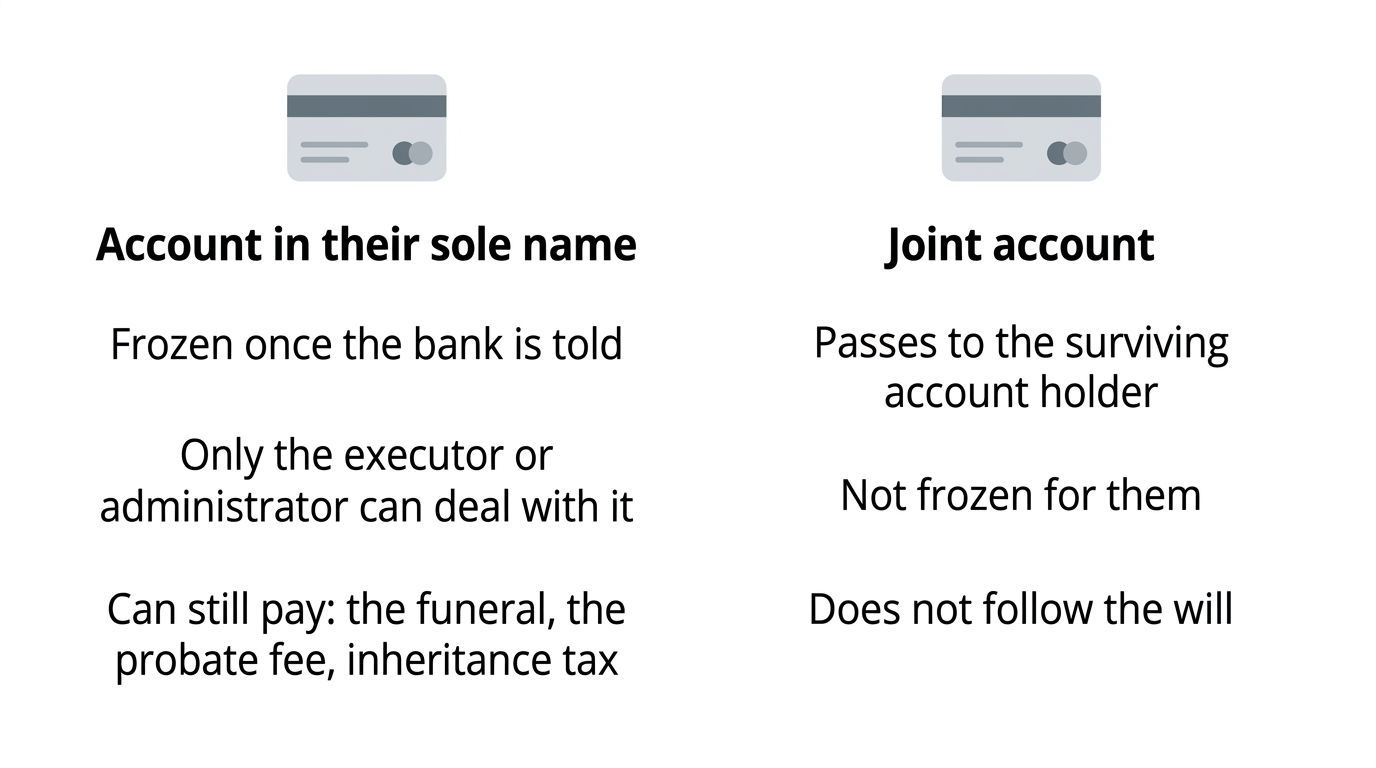
What happens to a bank account when someone dies depends on whether it was in their sole name or held jointly. A sole account is frozen once the bank is told, and only the executor or administrator can deal with it. A joint account usually passes straight to the surviving account holder.
This guide explains how that works in England and Wales, in plain terms, and what you can safely leave until later. Most families have never had to deal with this before, so it is completely normal not to know.
The short answer, for families dealing with a loved one's bank accounts in England and Wales
• A bank account in the person's sole name is frozen once the bank knows about the death.
• Next of kin cannot withdraw money from it. Only the executor named in the will, or an administrator if there is no will, can deal with the account.
• Many banks will still pay the funeral director directly, and can pay inheritance tax to HMRC, before probate.
• A joint account usually passes straight to the surviving account holder and is not frozen for them.
• If you have already used the card or taken money out, stop, tell the executor and keep every receipt.
In this guide
• Can next of kin withdraw money from a deceased person's bank account?
• Why the bank freezes the account, and why you need to tell them
• What a frozen account can still pay for
• Can you use a deceased person's bank account to pay for their funeral?
• I've already used their card or taken money out. What now?
• What happens to a joint bank account when someone dies?
• How to find a deceased person's bank accounts
• How to close a bank account when someone dies
• What needs doing now, and what can wait
Can next of kin withdraw money from a deceased person's bank account?
No. Next of kin cannot withdraw money from a bank account in the dead person's sole name. Being their husband, wife or eldest child does not give you that right either. From the moment of death, the money belongs to their estate, and only the person legally responsible for the estate can deal with it.
That person is called the personal representative. GOV.UK explains that a personal representative is either:
• an executor, the person named in the will to deal with the estate, or
• an administrator, if there is no will. This is normally the closest living relative: the husband, wife or civil partner, then any children aged 18 or over, following the order GOV.UK sets out. Our guide to the intestacy rules explains who inherits when there is no will.
Often the next of kin and the executor turn out to be the same person. The difference matters because the bank will only deal with you in that legal role, not because of your relationship to the person who died. It also means a power of attorney no longer helps: a power of attorney ends when the person dies, even if you used it to run their account for years.
Why the bank freezes the account, and why you need to tell them
Once a bank or building society is told about a death, it freezes any account in that person's sole name. Cards stop working, online banking is closed, and direct debits and standing orders stop. The Gazette advises letting the companies paid by direct debit know first, so they understand why the payments have stopped.
Some people wonder whether it would be simpler not to tell the bank for a while. It is not something to do. The freeze protects the estate: it stops payments going out that should not, and it stops anyone taking money that is not theirs. Telling the bank is part of dealing with the estate properly, and the executor or administrator will need to do it before any money can be released.
Freezing the account does not mean the money is lost. It stays in the account until the bank is shown who has authority to deal with it.
What a frozen account can still pay for
Even before probate, a frozen account is not completely locked. Many banks will release money for a few specific purposes, although Citizens Advice notes that this depends entirely on each bank's own policy.
• The funeral. Many banks will pay the funeral director directly from the account. Some will also pay the probate application fee.
• Inheritance tax. HMRC's Direct Payment Scheme lets the executor or administrator pay inheritance tax straight from the deceased's bank or building society account using form IHT423. GOV.UK confirms that tax can be paid from the deceased's accounts. Our inheritance tax guide explains when tax is due.
• Small balances. Each bank sets its own limit. Below it, the bank may release the money to the executor or administrator without probate, usually after they sign a form called an indemnity. An indemnity is a written promise to cover the bank if the money later turns out to belong to someone else. Above it, the bank will want to see the Grant of Probate, the court document that confirms the executor's authority. If there is no will, the equivalent document for an administrator is called Letters of Administration.
Those limits differ widely from one bank to another. Our guide to how much money can be in the bank before probate is needed lists the main banks' current limits.
Can you use a deceased person's bank account to pay for their funeral?
You can usually use a deceased person's bank account to pay for their funeral, but through the bank, not with their card. The normal route is for the bank to pay the funeral director directly. You give the bank a copy of the death certificate and the funeral director's itemised invoice. The bank then pays it from the account, as long as there is enough money in it. Citizens Advice notes that some banks will release money for the funeral, probate fees and inheritance tax before probate, but nothing else.
Banks differ on whether they will refund a family member who has already paid. If you are paying yourself and plan to claim it back from the estate, keep the invoice and receipt, and check with the bank first.
If there is not enough money for the funeral and you get certain benefits, you may be able to get a Funeral Expenses Payment from the government. GOV.UK explains that the payment is deducted from any money you later receive from the estate.
I've already used their card or taken money out. What now?
Money in a dead person's sole account belongs to their estate, so anyone who takes it without authority has to account for it to the executor or administrator. That is the legal position in a sentence. It also happens far more often than people admit. In the first days after a death, using mum's card to pay for the flowers, or moving money to cover a bill, can feel like the obvious thing to do. If you have done it, you are not alone, and the best thing now is to put it right openly. Using their card, PIN or online banking after death is not the proper way to access it, even if the money is being spent on estate expenses. If you have already taken or transferred money, stop using the account, keep a clear record of what was taken and why, and tell the executor or administrator so it can be accounted for in the estate.
The reason is simple. From the moment of death, the money belongs to the estate, not to the family. It has to be accounted for, because the estate may need it to pay debts and it may be due to other people under the will or the intestacy rules.

What to do now:
• Stop using the card, PIN or online banking straight away.
• Tell the executor or administrator what was taken, when, and what it was spent on.
• Keep every receipt. If the money went on the funeral or the person's own bills, the executor needs to know that when the estate's accounts are drawn up.
• Make sure the bank knows about the death. If you are named as executor but are not sure you want to take the role on, read the next paragraph before you contact the bank yourself.
If the amount is large, or other family members are unhappy about it, get advice early. Disputes over how estate money has been used are one of the things our contentious probate team deals with.
One more point if you are named as executor in the will. The Gazette explains that doing an executor's tasks, even something as small as letting a bank know of the death, can stop you from later stepping down from the role. Arranging the funeral does not count. If you are not sure you want to act, take advice before you deal with the accounts. Our guide to being an executor of a will explains the role.
What happens to a joint bank account when someone dies?
A joint account usually passes automatically to the surviving account holder. This is called the right of survivorship: when one joint owner dies, the money passes to the other owner automatically, outside the will. The Gazette confirms that most UK joint bank accounts work this way. The account is not frozen for the survivor, and probate is not needed for it. You tell the bank, show the death certificate, and the bank will usually move the account into your sole name.
Two things often surprise people:
• It does not follow the will. Money that passes by survivorship goes to the surviving account holder, whatever the will says.
• It can still count for inheritance tax. The person's share of a joint account is still part of their estate for tax purposes. GOV.UK confirms that what is left to a husband, wife or civil partner is exempt. For other joint holders, such as a parent and child, The Gazette explains that HMRC usually treats each person as owning a share in proportion to what they paid in.
Sole and joint accounts at a glance
| Account in their sole name | Joint account | |
|---|---|---|
| Frozen when the bank is told? | Yes | Not for the surviving account holder |
| Probate needed to get the money? | Only above the bank's own limit | No, for that account |
| Who the money goes to | The estate, then shared out under the will or the intestacy rules | The surviving account holder, but beneficial ownership can depend on the account terms, contributions and intention. |
| Does the will decide? | Yes | Usually not where the money passes by survivorship. |
| Counts for inheritance tax? | Yes | The person's share does - HMRC commonly looks at contributions for joint money accounts |
Sources: The Gazette on bank accounts after a death and joint accounts and inheritance tax, and Citizens Advice.
When a parent added a child "just to help"
Many older people add a son or daughter to their account so that they can help pay the bills. When the parent dies, the survivor may assume the money is now theirs, while brothers and sisters expect it to be shared under the will. HMRC’s guidance recognises that, where an account was held jointly only for convenience and the deceased provided all the funds, the whole balance may be treated as the deceased’s for Inheritance Tax purposes.
If this is causing disagreement in your family, our contentious probate page explains how these disputes are resolved.
How to tell the banks
Each bank has its own bereavement team and its own paperwork, and families often find they get different answers from different banks. Two free services can take some of that load off:
• The Death Notification Service lets you notify a number of banks and building societies at once. Each member organisation that holds an account will contact you within 10 working days to explain the next steps.
• Tell Us Once lets you report the death to most government organisations in one go, such as HMRC and the DWP. The registrar explains it when you register the death, and you must use it within 28 days of getting your reference number. It does not tell the banks.
The bank will usually ask for a copy of the death certificate, proof of your identity, and, once it has been issued, the Grant of Probate or Letters of Administration.
How to find a deceased person's bank accounts
To find a deceased person's bank accounts, start with their post, bank statements and emails. Then try My Lost Account, a free search of banks, building societies and NS&I. With paperless banking, families often have no idea where the accounts are, so look too for regular payments into or out of the accounts you do know about. The Gazette's guidance suggests the executor starts with the paperwork and then searches more widely.
For accounts that seem to have been forgotten, My Lost Account is a free service that searches for lost bank, building society and NS&I accounts. The Death Notification Service can also help, because any member bank that holds an account will get in touch.
How to close a bank account when someone dies
To close a sole account, the executor or administrator normally gives the bank:
• a copy of the death certificate
• proof of their own identity
• the bank's own bereavement form, and an indemnity if the balance is under the bank's limit
• the Grant of Probate or Letters of Administration if the balance is over the limit
The bank then pays the money to the executor or administrator, often into a separate account opened to hold the estate's money while it is being dealt with. GOV.UK calls this an executorship account. The money is not paid straight to the family, because debts and tax have to be dealt with before anything is shared out. Release times vary by bank and by the circumstances, so no single timescale should be stated here.
If the estate has debts, the executor must deal with those before paying beneficiaries. Our guide to debts after death explains what happens to debts, and why the family does not inherit them. For how long the whole process usually takes, see how long probate takes.
What needs doing now, and what can wait
Grief makes everything feel urgent. In reality, only a few things need doing in the first days, and most money decisions are better made later, when you know what the estate contains.
What needs doing soon:
• register the death and get copies of the death certificate
• arrange the funeral and ask the bank to pay the funeral director
• tell the banks, and stop using any cards
• keep the home and any valuables safe
What can wait:
• closing every account and moving money around
• paying anyone other than the funeral director before the executor or administrator is clear about the estate
• selling anything, or sharing money out between family members
• clearing the house. Our guide to house clearance after death explains who can do this and when.
There is no prize for doing it all quickly. It is far better to do it once, in the right order.
Client story:
We acted for a family after a husband died without a will. His estate included property overseas, a business interest, and children who were still minors. Because there was no will, nobody had automatic authority to deal with his affairs. We advised the family on the intestacy rules and prepared a comprehensive application to HMRC to show that no inheritance tax was due – which was a brilliant outcome for the client considering the size of the estate. We set up a bereaved minors’ trust for the children and obtained the Grant of Letters of Administration despite a long-running disagreement with his business partners. The estate was settled without an unnecessary tax bill and without a court battle.
Frequently asked questions
Is a bank account frozen when someone dies?
A sole account is frozen once the bank is told about the death. A joint account is not frozen for the surviving account holder, who can usually carry on using it.
Do you need probate to access a deceased person's bank account?
Not always. If the balance is under the bank's own limit, the bank may release it to the executor or administrator without probate. Above the limit, the bank will ask for the Grant of Probate or Letters of Administration. See how much money can be in the bank before probate is needed.
Can I pay bills from a deceased person's bank account?
Not directly. Once the account is frozen, the bank will normally only pay for the funeral, the probate fee and inheritance tax before probate. Other bills are paid by the executor or administrator from the estate later. Our guide to debts after death explains what happens to bills and debts.
Can I still use a power of attorney after they have died?
No. A power of attorney ends when the person dies. From then on, only the executor or administrator can deal with their money.
What if the account is overdrawn?
An overdraft on a sole account is a debt of the estate, not of the family. If it was a joint account, the surviving account holder can still be asked to repay it, as Citizens Advice explains.
Does this apply in Scotland or Northern Ireland?
No. This guide covers England and Wales only. Scotland has its own system, where the equivalent of probate is called confirmation, and Northern Ireland has its own rules too.
Talk it through with us
So, can next of kin take money out of a deceased person's account? Not on their own. The bank will deal with the executor or administrator, it will usually pay for the funeral in the meantime, and a joint account normally passes straight to the survivor.
This guide is general information about the law in England and Wales. It is not advice on your family's situation, which will always depend on the facts.
Not sure where you stand with a loved one's accounts, or has the bank asked for a grant before it will release the money? We can help you work out what comes next. Call us on 0208 515 2790 for a free, no-obligation 20-minute chat, or send us an enquiry.

Author Bio:
Nasreen Akhter is the founding director of Ash Hill Solicitors and a private client solicitor with over a decade of experience in probate, wills, estate planning and elderly client care. Known for her calm, compassionate approach, she guides individuals and families through life's most sensitive legal matters with clarity and care.
Nasreen is also an accredited civil and commercial mediator, and is listed on the Solicitors Regulation Authority (SRA) register. Outside of work, she's a dedicated mum and chairs Happy Orphans Worldwide, a charity supporting vulnerable children worldwide.