
Property During Probate
When someone dies and leaves a house behind, that house usually becomes the biggest thing on the executor's list and the one causing the most worry. Can you sell it? Do you need to wait? Who is responsible for it in the meantime? Most people asking these questions have never dealt with an estate before, and there is no reason they should have.
This page walks through what happens to a property during probate in England and Wales, from the moment someone dies to the point the house is sold or transferred. The law is different in Scotland and Northern Ireland.
At a glance
- The property belongs to the estate from the moment of death. The executors hold it, but they cannot transfer it to a buyer until the court confirms their authority. This authority is usually provided in the form of a Grant of Probate.
- You can put a property on the market and accept an offer before the Grant of Probate is issued. In most cases, you will need to wait for the Grant of Probate before exchanging contracts or completing the sale.
- Where the house was owned as joint tenants, it passes straight to the surviving owner and probate may not be needed at all.
- Inheritance tax is usually due six months after the end of the month of death, which often falls before the house can be sold. There are ways to handle that, and they are set out below.
- An empty property will usually be exempt from Council Tax while you are waiting for probate, provided the relevant conditions are met.
- The value agreed for probate becomes the starting point for capital gains tax later, so the two decisions are connected.
What is probate property?
"Probate property" simply means a property that formed part of someone's estate when they died and now has to be dealt with as part of administering that estate.
The court document that gives you authority to deal with the estate is a Grant of Probate where there is a valid will, or Letters of Administration where there is not. Both do the same job: they prove to banks, buyers and the Land Registry that you can act. Our guides to what probate is and how much an estate has to be worth to go to probate cover the wider process and the thresholds.
Who owns a property during probate?
During probate, the executors are responsible for dealing with the property on behalf of the estate. The beneficiaries are entitled to the property it, or to the proceeds, but only once the estate has been administered.
That split trips most people up, so it is worth taking in two parts.
Legal ownership passes to the executors. From the date of death, the executors hold the property on behalf of the estate. They are responsible for it, they must insure and maintain it, and they are the ones who will eventually sell or transfer it. Until the Grant of Probate is issued, though, their authority has not yet been confirmed by the court, which is why a sale cannot complete.
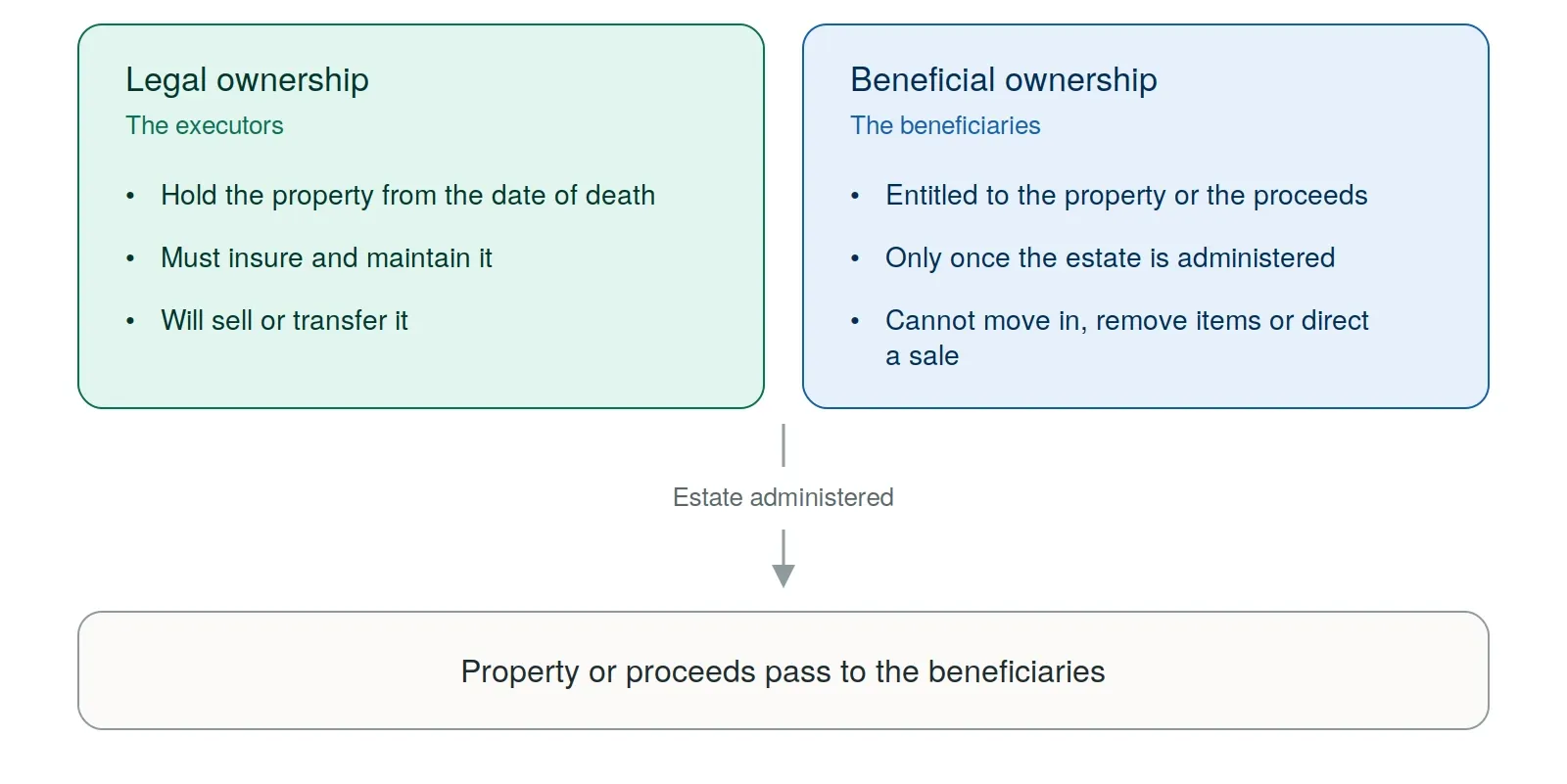
Beneficial ownership belongs to the beneficiaries. The people named in the will (or entitled under the intestacy rules) are the ones who will ultimately receive the property or the proceeds from it. What they do not have is the right to move in, take items out, or direct a sale before the estate is administered.
So a beneficiary who has inherited the house does not own it yet. The executors remain responsible for dealing with it until the estate has been administered and the property is transferred to the beneficiary. That distinction matters more than it sounds, and it is the source of a great many family disagreements.
One important exception. How the property was jointly owned can take it out of the estate altogether, which changes everything that follows. We set out what that means for a sale in selling a jointly owned property below.
Valuing the property for probate
You will need a value for the property as at the date of death. That figure does two jobs. It goes into the inheritance tax calculation now, and it becomes the base cost for capital gains tax if the property is later sold for more.
For smaller estates comfortably under the tax thresholds, written valuations from estate agents are usually accepted. Where inheritance tax is payable, or where the property is unusual, a formal valuation from a RICS surveyor is the safer route, because HMRC can refer a valuation to the District Valuer for checking.
Getting this figure wrong in either direction costs money, and the reasons why are set out in our full guide to valuing a property for probate.
Paying inheritance tax when the estate's main asset is the house
If the estate you are dealing with is mostly a house, there is a timing problem waiting for you, and it catches almost every executor.
Inheritance tax on an estate is usually due six months after the end of the month in which the person died. You normally cannot get the Grant of Probate until the tax has been dealt with, and you cannot complete a sale of the house without the grant. So the money you need to pay the tax is locked inside the asset you cannot sell until you have paid the tax.
It is a genuine catch, not a mistake you have made, and there are three established ways through it.
Paying in yearly instalments
Property is one of the assets HMRC allows you to pay inheritance tax on in instalments. You can spread the inheritance tax on the house over 10 equal annual payments rather than finding the whole amount at once.
The rules on yearly instalments set out the detail. The first instalment falls due at the end of the sixth month after death, and the rest are due annually on that same date. Interest is usually charged on the outstanding amount, although not on the first instalment unless you pay it late.
The important condition: when you sell the property, the outstanding balance becomes payable in full. Instalments buy you time to sell properly rather than in a hurry. They do not reduce the bill.
The Direct Payment Scheme
Where the person who died held money in a bank, building society or investment account, that money can go straight to HMRC to pay the inheritance tax before the grant is issued. The bank pays HMRC directly, so you are not asked to fund the tax yourself.
You do this using form IHT423, submitted alongside the IHT400. Most banks and building societies take part in the scheme, so that the money can be paid directly to HMRC.
This is the first thing to check, because it solves the problem outright where the estate holds enough cash.
If there is no cash in the estate
Some estates are the house and almost nothing else. Where instalments are not enough and there is no cash to draw on, executors sometimes borrow against the estate, either through an executor's loan or bridging finance.
We would treat that as a last resort, and we would want you to see the cost before you commit to it. Bridging finance is expensive, it is secured against the property, and the interest runs until the sale completes. For most estates, instalments combined with a properly marketed sale work out better. If someone is recommending bridging to you before instalments have been considered, ask them why.
For the thresholds, reliefs and how the tax is calculated, see our guide to inheritance tax.
Worth a conversation early. Of everything on this page, this is the part where the order you do things in makes the most difference, and it is the hardest to unpick afterwards. If the estate you are dealing with is mostly a house, a short conversation now is usually enough to work out which of these three routes fits. Our first 20 minutes are free, and there is no obligation to instruct us. Call 0208 515 2790.
Selling a property during probate
Do you need probate to sell the property?
In most cases you do need probate to sell a house after someone dies. If the property was in the deceased's sole name, you will normally need probate before the sale can be completed. A buyer's conveyancer will want to see the Grant of Probate before the sale can complete, because it is the document proving the sellers have the authority to transfer the property.
The exception is a property held as joint tenants, which passes to the surviving owner automatically and can be sold without a grant. If the property was in the deceased's sole name, or held as tenants in common, you will need one.
What if there is no will?
The process is the same, but the document is different. Instead of a Grant of Probate, the people entitled under the intestacy rules apply for Letters of Administration. Once that is issued, the administrators can deal with the property exactly as executors would.
The practical difference is timing. Working out who is entitled to apply takes longer where there is no will, particularly in blended families or where relatives are hard to trace, and the property sits waiting while that happens.
Can you sell before the Grant of Probate is issued?
You can market a house and accept an offer before the Grant of Probate is issued, but in most cases you cannot exchange contracts or complete the sale until the grant arrives. In short, you can do most of a sale before probate. You cannot finish it.
| You can do this before the grant | You cannot do this until the grant is issued |
|---|---|
| Instruct an estate agent and market the property | Exchange contracts |
| Hold viewings | Complete the sale |
| Accept an offer, subject to probate | Transfer the property to a buyer or a beneficiary |
| Instruct a conveyancer and start the legal work | Grant a tenancy |
| Obtain an Energy Performance Certificate | Distribute the sale proceeds |
Marketing early is often the sensible choice, because it means the sale and the grant progress alongside each other rather than one after the other. It carries one real risk, and it is worth being straight about it: a buyer who is in a hurry may walk away when they learn the grant has not been issued yet. Tell buyers upfront that the property is subject to probate. The ones who withdraw were always going to withdraw, and better at the start than after they have paid for a survey.
Selling a jointly owned property
How the property was jointly owned decides everything. GOV.UK sets out the two forms of joint property ownership: with joint tenants, "the property automatically goes to the other owners if you die", while with tenants in common, "your share of the property does not automatically go to the other owners if you die".
Here is what that means in practice.
| Joint tenants | Tenants in common | |
|---|---|---|
| What happens on death | The whole property passes automatically to the surviving owner under the right of survivorship | Only the deceased's share passes under their will or the intestacy rules |
| Does it form part of the estate? | No | Yes, the share does |
| Is probate needed for it? | No | Yes, before the share can be dealt with |
| Can it be sold straight away? | Yes, the surviving owner sells as the owner | No, not until the Grant of Probate is issued |
| What the Land Registry needs | A death certificate to update the title | The grant, plus the usual transfer documents |
In practice, where a property is held as tenants in common, the whole thing usually has to be sold together, which means the surviving co-owner and the executors need to agree a course of action. That is a common source of friction, particularly where the co-owner still lives there.
If you are not sure which applies, the title register at the Land Registry will tell you. A restriction on the title usually indicates tenants in common.
The sale process, step by step
Here is the order things happen in, and where the estate work sits alongside the property work.
- Value the property as at the date of death, for the inheritance tax account.
- Report and pay inheritance tax, using the Direct Payment Scheme or instalments where appropriate .
- Apply for the Grant of Probate or Letters of Administration.
- Decide how to sell, or whether to sell at all. Private treaty through an estate agent is the usual route. Auction can suit a property in poor condition or where speed matters more than price, but it commits you to completing within a set period once the hammer falls.
- Instruct a conveyancer to handle the sale itself.
- Get an Energy Performance Certificate. GOV.UK requires you to order an EPC before you market a property, and one lasts 10 years, so check whether the person who died already had one before paying for another.
- Insure and secure the property for the whole period it sits empty. This is covered in more detail below.
- Accept an offer and progress the legal work.
- Exchange contracts once the grant has been issued.
- Complete the sale, clear the property, settle any remaining estate liabilities and distribute the proceeds to the beneficiaries in line with the will or the intestacy rules.
A note on who does what. We are a private client firm, and we handle the estate side: the valuation and tax position, the probate application, the grant, and distributing the proceeds properly at the end. The conveyancing itself, meaning the legal transfer of the property to the buyer, is done by a conveyancer, and we will work alongside yours so the two halves stay in step. We would rather tell you that plainly than have you find out midway through.
Selling versus transferring to a beneficiary
Not every property in an estate gets sold. If the will leaves the house to a named person, or the beneficiaries would rather keep it than sell it, the executors can transfer it to them instead.
The mechanism is different from a sale. Where the whole registered property is being transferred to a beneficiary, tThe executors sign an assent, using HM Land Registry form AS1, "whole of registered title: assent", and the property is registered in the beneficiary's name. There is no buyer, no estate agent and no chain.
Whether it is possible depends on three things:
- Does the will direct it? If the property is left to a named beneficiary, transferring is the default and selling would need a reason.
- Do all the beneficiaries agree? Where the estate is shared and one person wants the house, they usually have to compensate the others out of their own funds.
- Is there cash elsewhere to pay the tax and the debts? If the house is the only significant asset and inheritance tax is due, transferring it may simply not be an option. The estate has to be able to meet its liabilities first.
One thing in its favour: a transfer under a will is not a purchase, so no stamp duty is payable on it.
Beneficiary consent and disputes
Property is the asset families fall out over, and executors are often caught in the middle of it.
Can an executor sell without the beneficiaries' approval?
Generally, yes. An executor's job is to administer the estate, which includes selling assets where that is needed to pay debts, settle inheritance tax, or divide the estate between several beneficiaries. Beneficiaries do not have a veto over that.
What executors do owe is a duty to act in the beneficiaries' interests as a whole, and to obtain a proper price. Selling quickly and cheaply for convenience, or selling to a friend or family member below market value, is where executors get themselves into difficulty. Get the property properly valued, market it openly, and keep a record of the offers received.
Where the will gives a specific property to a specific person, the position changes. That gift has to be honoured unless the estate cannot meet its debts without selling.
Can a beneficiary stop the sale?
Not usually by simply objecting. A beneficiary who believes the executor is acting improperly, selling at an undervalue, or failing to act at all, can apply to the court, and in serious cases the court can remove an executor and appoint someone else.
That is a significant step and it is expensive. Most disagreements are better resolved by the executor being open about what they are doing and why: sharing the valuations, explaining the offers, and setting out the tax position. Beneficiaries usually object because they feel excluded rather than because the decision is wrong.
If a dispute has already gone beyond that point, our contentious probate page covers what happens next.
When beneficiaries disagree with each other
Where several people inherit a share of a property and they want different things, one wanting to sell and another to keep it, the estate cannot be finalised until it is resolved. The usual outcome is that whoever wants to keep the property buys out the others at a valuation they all accept. Where no agreement is possible, t the property may ultimately have to be sold and the proceeds divided. In more difficult cases, legal advice or court involvement may be needed.
An executor caught between beneficiaries should take advice early. Acting on one beneficiary's wishes over another's leaves you personally exposed, and it is a difficult position to be in when the people involved are your own family. More on what the role requires is on our executor of a will page.
How a dispute can stop the sale completely
There is one part of this that surprises executors, and it is worth knowing about before it happens to you.
Anyone aged 18 or over with an interest in an estate can enter a caveat at the probate registry. A caveat is a formal notice that, in GOV.UK's words, "stops all applications for probate on the estate being granted during that time". It lasts 6 months at first and can be extended for another 6.
No grant means no authority to transfer the property, which means contracts cannot be exchanged and the sale cannot complete. The house stops where it is until the caveat is resolved or removed.
That is a serious consequence for a step that takes very little effort to take, and it is why disputes about an estate are rarely just about the estate. They hold up the property too.
We acted for a woman whose late husband had left most of his estate to his adult children from an earlier marriage, leaving her without adequate provision. We entered a caveat on her behalf to hold the Grant of Probate while the position was addressed, then represented her through negotiation and mediation. The matter was settled between the parties without court proceedings.
The reason we mention it here is timing. Caveats and claims against an estate are far easier to deal with early, before positions harden and before costs mount. If you are an executor and someone has told you they intend to challenge the will, or you are a beneficiary who thinks you have been left out unfairly, that is the moment to take advice, not six months later.
If you are stuck in the middle of this, you do not have to be. Being the executor and the sibling at the same time is genuinely hard, and having someone outside the family make the decisions takes the personal weight out of it. We have done this many times, and a lot of it never gets as far as a dispute once someone neutral is handling the correspondence. Talk it through with us on 0208 515 2790, free and without obligation.
How long can a property stay in probate?
There is no legal deadline by which an executor must sell a property. What there is instead is a convention known as the executor's year.
It comes from section 44 of the Administration of Estates Act 1925, which says that "a personal representative is not bound to distribute the estate of the deceased before the expiration of one year from the death". Beneficiaries cannot compel distribution before that year is up. After it, they can begin to press for progress and, in some cases, ask the court to intervene.
The executor's year is widely misunderstood as a deadline to sell the house. It is not. It is the point from which an executor may be asked to explain a delay, and estates routinely and legitimately take longer.
Timescales for the grant itself change, and the probate service publishes current processing times, so it is worth checking rather than relying on a figure someone quoted you. Our page on how long probate takes goes into this in more detail.
Things that genuinely extend the process:
- Inheritance tax has to be settled before the grant is issued
- The will is disputed, or a claim is made against the estate
- Beneficiaries cannot be found
- The property does not sell, or a sale falls through
- The estate includes foreign assets or complex trusts
None of those are failings on the executor's part. They are reasons, and a good executor tells the beneficiaries about them as they arise.
What you can and cannot do with the property before the grant
Executors regularly ask whether they can start dealing with the house while they wait. T There are plenty of practical things executors can do with the property while they wait for the grant, but significant steps such as completing a sale or distributing estate assets will usually need to wait. Acting too soon can create problems and, in some cases, leave an executor personally responsible for a loss.
Can you empty or clear the house before probate?
Before probate is granted you can enter the property, secure it, and remove perishable items and anything at risk of theft or damage. What you should not do is dispose of, sell or distribute the contents.
The reason is practical rather than bureaucratic. The contents form part of the estate and have to be valued for inheritance tax. Once items are gone, that valuation cannot be done properly, and if a dispute arises later there is no record of what was there. Photograph the contents, keep anything of value, and wait.
Where family members are keen to take mementoes, the safest approach is to make a list of who has taken what and agree it with the other beneficiaries. It sounds excessive. It prevents a great deal of unpleasantness later.
Can a beneficiary live in the property?
Only with the executors' agreement, and it needs thinking about carefully. Someone living in the property affects the insurance position, may affect the council tax exemption, and can make the property harder to sell. If the person living there is also a beneficiary, the other beneficiaries may reasonably ask whether they should be paying rent to the estate.
Where the person was already living there before the death, for example a surviving partner or an adult child, the position is different and usually more sympathetic, but it still needs to be addressed rather than left.
Can you rent it out?
Not before the grant, in most cases. Executors do not have the authority to grant a tenancy until their appointment is confirmed, and doing so creates an obligation the estate then has to honour. Renting out a probate property before the grant is issued can create legal and practical problems, so executors should take advice before granting a tenancy.
After the grant, letting is possible where the will or the beneficiaries permit it, though it brings the estate into landlord obligations, tax on the rental income, and the practical difficulty of selling a tenanted property later. It is rarely the simpler option it appears to be.
Your obligations while the property sits empty
While the estate is being administered, the executors are responsible for the property. This is the part of the role people underestimate, and it is where personal liability most often arises.
Insurance. Buildings policies commonly restrict or withdraw cover once a property has been standing empty for a set period, and that period is usually short. Check the policy wording rather than assuming, and tell the insurer about the death straight away. Unoccupied property insurance is a specific product and it costs more than a standard policy. If the property is uninsured and something happens, the loss falls on the estate, and beneficiaries can look to the executor for it.
Council tax. This is more generous than most executors expect. According to GOV.UK, where you are selling a property on behalf of someone who has died, no council tax is payable until after probate is granted, provided the property stays empty. After the grant, a further six months' exemption may apply while the property remains unoccupied and still in the name of the person who died.
There is also relief from the empty property premium, the higher charge councils apply to long-term empty homes, for up to 12 months after the grant where the property is being marketed for sale or to let. Tell the council about the death promptly, because these exemptions are applied on request rather than automatically.
Security and maintenance. Keep the property looking occupied and maintained. Clear the post, keep the heating on low in winter to prevent burst pipes, check it regularly, and keep a record that you have done so. Where the property is some distance away, arranging for a neighbour or a firm to check on it is money well spent.
Personal liability. GOV.UK puts it plainly: as a personal representative "you're legally responsible for the money, property and possessions of the person who died", and that runs from the date of death until everything has been passed on to the beneficiaries. Executors can be held personally responsible for losses caused by failing to look after estate assets properly. That is not a reason to panic. It is a reason to insure the property, tell the council, and keep notes of what you have done and when.
If you would rather not carry that responsibility on your own, we can take the administration on and deal with these obligations as part of it. There is no charge for the first conversation.
Stamp duty, land tax, and capital gains tax
Stamp duty on a probate property
Inheriting a property is not a purchase, so no stamp duty is payable when a property passes to a beneficiary under a will or the intestacy rules.
Two situations where it does come up:
· A beneficiary buys out the others. If you pay your co-beneficiaries for their shares, that payment is chargeable consideration and stamp duty may be due on it.
· You already own a home. Inheriting a share of a property can affect whether you pay the higher rate of stamp duty on a future purchase, depending on the size of the share and how long you hold it.
Capital gains tax between the probate value and the sale price
The value agreed with HMRC at the date of death becomes the estate's base cost. If the property later sells for more than that figure, the difference is a gain, and capital gains tax may be due on it.
Estates have their own annual exempt amount, available for a limited period after the death, so a modest gain may produce no tax at all. Selling reasonably promptly after the grant usually keeps the gain small in any case, because there is less time for the market to move.
Where a gain does arise, the reporting deadline is short. You must report and pay capital gains tax on UK residential property within 60 days of completing the sale. That is a separate return from the estate's other tax filings and it is easy to miss.
The trade-off worth understanding. A low probate valuation reduces the inheritance tax, which is charged at a higher rate. A high probate valuation reduces the capital gains tax on any later sale. You cannot optimise both, and the right answer depends on whether inheritance tax is actually payable on the estate.
If the estate falls comfortably below the tax thresholds and the house is likely to sell quickly, arguing the valuation down achieves nothing and creates a capital gains bill. If inheritance tax is payable, the calculation is different. This is a decision to make deliberately at the valuation stage, not something to discover after the sale.
If you would like some help with this
Dealing with a property is usually the heaviest part of administering an estate, and it is the part where getting the order of things wrong costs the most. If you are an executor and you are not sure where to start, or you have started and something has become complicated, we are happy to talk it through with you.
We offer a free, no obligation 20-minute chat, and we work on fixed fees for probate, which are published on our fees page so you know the cost before you commit. If you cannot travel to us, we visit clients at home, in hospital and in hospices.
Call us on 0208 515 2790, or get in touch and we will come back to you.
Frequently asked questions
Can a property be sold or put up for sale before probate is granted?
It can be marketed and an offer can be accepted, and doing so before the grant is common and usually sensible, as long as buyers are told the sale is subject to probate. Contracts cannot be exchanged and the sale cannot complete until the Grant of Probate or Letters of Administration is issued.
How long after probate is granted can you sell the house?
As soon as the grant is issued, the executors can exchange and complete. If the property was marketed while the application was progressing, completion can follow quite quickly afterwards.
Do you have to sell a house during probate?
No. Where the will leaves it to a named beneficiary, or the beneficiaries agree to keep it, the executors can transfer it instead, provided the estate can meet its debts and any inheritance tax without the sale proceeds.
Are probate properties cheaper to buy?
Not necessarily. Executors have a duty to obtain a proper price, and most probate properties are marketed openly. Where they do sell below market value it usually reflects the condition of the property rather than the circumstances of the sale.
Who is responsible for the house between the death and the sale?
The executors, or the administrators where there is no will. That includes insuring it, securing it, maintaining it, and dealing with the council tax position.
What happens to the mortgage during probate?
The mortgage does not disappear on death. Interest usually continues to accrue, and the lender should be told promptly. Some estates are covered by life insurance that repays it. Others need the property sold to clear it, which is another reason not to leave the sale too long.

Author Bio:
Nasreen Akhter is the founding director of Ash Hill Solicitors and a private client solicitor with over a decade of experience in probate, wills, estate planning and elderly client care. Known for her calm, compassionate approach, she guides individuals and families through life's most sensitive legal matters with clarity and care.
Nasreen is also an accredited civil and commercial mediator, and is listed on the Solicitors Regulation Authority (SRA) register. Outside of work, she's a dedicated mum and chairs Happy Orphans Worldwide, a charity supporting vulnerable children worldwide.