
House Clearance After Death: Who Can Clear It and Who Pays
Walking back into a parent's home after they have died is hard. Their coat is still on the hook and the post is still arriving. Sooner or later, someone says the house needs clearing, and nobody is quite sure who is allowed to do it, how soon, or who pays.
House clearance after a death means emptying the home of someone who has died: deciding what is kept, passed to family, sold, donated or thrown away. This guide explains it in England and Wales from the legal side. It covers who is responsible for clearing the house, what you can do before probate and what should wait. It also explains what changes if your parent rented from the council or a housing association.
This guide is for families clearing a parent's or relative's home in England and Wales. The short answer: house clearance after a death is paid for from the estate of the person who died. It is organised by the executor, or by an administrator if there is no will. You can secure the house straight away. Selling, giving away or throwing out belongings should wait until everything has been listed and valued.
• Belongings are part of the estate and count towards its value for inheritance tax.
• Being next of kin, or being left an item in the will, does not give you the right to take things early.
• If your parent rented from the council or a housing association, the landlord usually gives about 4 weeks to clear the home once it serves notice. Rent is paid from the estate until the tenancy ends.
• Keep a list, photographs and every receipt.
In this guide
• Can you empty a house before probate?
• Who is responsible for clearing the house?
• Who pays for house clearance after death?
• Council house clearance after a death
• When siblings disagree about the contents
Can you empty a house before probate?
You cannot usually empty a house completely before probate. You can protect the house and its contents straight away. Emptying it, selling things or sharing them out should wait until the belongings have been listed and valued and the executor agrees. If there is no will, it should also wait until an administrator has been appointed through Letters of Administration. Until then, nobody has the authority to deal with the estate. Until they are passed on, the contents belong to the estate, not to the family.
Probate is the legal right to deal with someone's money, property and possessions after they die. The court document that proves it is called a Grant of Probate, or Letters of Administration if there is no will. GOV.UK explains when you need to apply.
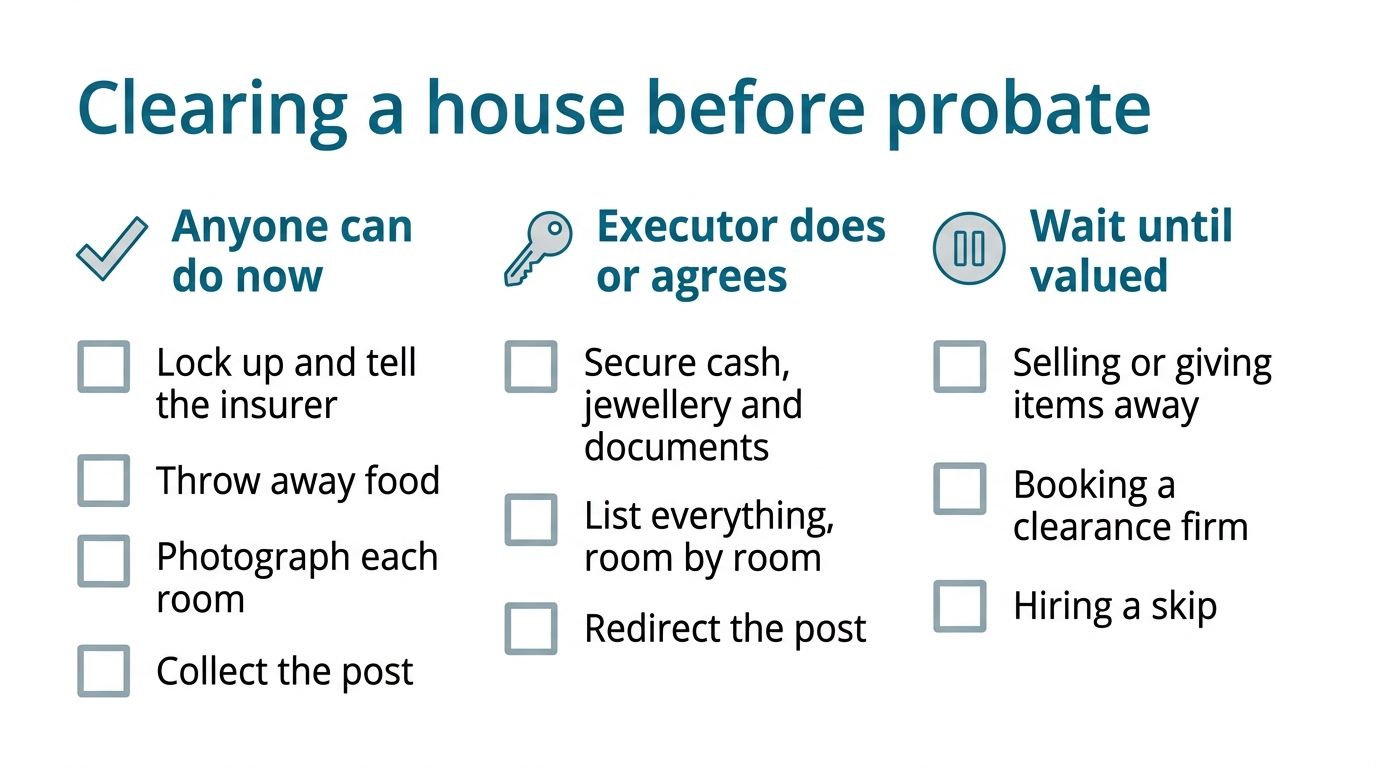
What anyone in the family can do straight away
These steps simply keep the house and its contents safe:
• Lock up, check the windows, and tell the home insurer that the house is empty.
• Throw away food and anything perishable, and deal with anything unsafe.
• Photograph each room before anything is moved.
• Collect the post and keep it together for whoever deals with the estate. It often reveals accounts and policies nobody knew about.
What the executor should do, or agree to
These steps involve dealing with the estate's belongings, so they are for the executor, or for someone the executor has asked to help:
• Move cash, jewellery, documents and anything valuable somewhere secure, and write down what was moved and where it is.
• Make an inventory, room by room, noting anything that might be worth something.
• Arrange for the post to be redirected.
Removing items before probate: what should wait
Before probate, removing items, selling furniture or handing out belongings should wait until the contents have been valued and the executor or administrator (personal representatives) agree. So should booking a full clearance or filling a skip. Once things have gone, nobody can value them, and if a question is raised later there is no record of what was there.
Family members often want a keepsake early, and that is completely understandable. However, valuable items and anything specifically gifted under the will should not be disposed of until Grant of Probate has been extracted.
One interesting issue could arise if you are named as an executor but are not sure you want to act. Dealing with the estate's belongings can count as taking on the role, and someone who has done that may not be able to step back from it later. The Gazette explains this rule, known as intermeddling. If you are undecided, keep to the first list, making the house safe, and leave the second list to someone else until you have taken advice.
Who is responsible for clearing the house?
The person responsible for clearing a house after a death is the personal representative. That is the executor named in the will or, if there is no will, the administrator appointed through Letters of Administration. They have the legal authority over the house and its contents. Where there is no executor able and willing to act, the person entitled to apply for a grant will depend on the circumstances and the applicable order of priority. GOV.UK says a personal representative is legally responsible for the money, property and possessions of the person who died. That responsibility runs from the date of death until everything has been passed on.
There is a difference between the two. An executor's authority comes from the will itself, so they can take practical steps before the grant, although banks, buyers and others will want to see the Grant of Probate. An administrator has no authority until Letters of Administration are issued. Our guide to what an executor does covers the role in more detail, and if there is no will, the intestacy rules decide who can apply.
Is it my job to clear mum's house?
Only if you are the executor or administrator, or they ask you to help. Being next of kin, a son or daughter, or a beneficiary does not on its own give you the right to clear the house. Nor does it let you take anything from it, even an item the will leaves to you. Gifts in a will are handed over by the executor once the estate is ready to be shared out.
If you are the executor, you can ask family to help or pay a clearance firm, but the responsibility stays with you.
Value the contents first
Household and personal belongings are part of the estate. For inheritance tax, GOV.UK says to value items such as cars, jewellery and paintings at what you would have got if you had sold them. Furniture, electrical goods, antiques and collections all count too.
For most homes, a careful list with sensible estimates is enough. Where there is jewellery, art, antiques or a collection, a professional valuation protects the executor if the figures are ever questioned. Our probate valuation guide explains how this works, and our guide to how jewellery is distributed under a will covers the items families most often disagree about.
Look carefully as you go. Cash in drawers, savings books, share certificates and letters from pension providers regularly turn up during a clearance. Anything found belongs to the estate and should be passed to the executor, not kept or shared out on the spot.
Who pays for house clearance after death?
House clearance after death is paid for by the estate. Clearing the house is part of the cost of dealing with the estate, so it comes out of the money the person left before anything is shared between the beneficiaries. If the executor pays upfront, they can usually be repaid from the estate, as long as the cost is reasonable and there is a receipt. The same applies to a family member who pays with the executor's agreement.
Clearance costs vary a great deal with the size of the home and how much is in it, so get two or three written quotes before you agree anything. A few practical points:
• Check that the firm is a registered waste carrier. Under section 34 of the Environmental Protection Act 1990, household waste should only go to someone authorised to take it. In England you can search the public register of waste carriers; in Wales the register is kept by Natural Resources Wales.
• Ask whether the quote allows for anything the firm can resell, and get that in writing.
• If belongings are sold, sell them at a fair price and keep a record, because the money belongs to the estate.
• Keep every receipt and invoice for the estate accounts.
Council house clearance after a death
After a council or housing association tenant dies, the family in England usually has about 4 weeks to clear the home once the landlord serves notice to end the tenancy. Rent is charged until the tenancy ends and is paid from the money the tenant left. That clock does not apply to a house your parent owned.
Shelter sets out the position in England:
• The tenancy does not end when the tenant dies. Anyone can tell the landlord about the death. Keep a note of who you spoke to and when.
• Most landlords then send a notice to end the tenancy, and you usually have about 4 weeks to clear the home once that notice is given. You can ask for more time or for help.
• Rent is charged until the tenancy ends, and it is paid from the money the tenant left. You do not have to pay it yourself unless you were a joint tenant.
• The landlord can charge for clearing anything left behind, but only from the tenant's money. You can ask them to drop the charge if paying it would cause hardship.
• You can offer to end the tenancy early by agreement. This is called a surrender, and it stops the rent. Shelter has a template letter for it.
Shelter also advises speaking to the rest of the family before you remove anything. It can cause problems if you do not have the right to deal with the belongings.
Owned home or council home: how they compare
| Home your parent owned | Council or housing association home (England) | |
|---|---|---|
| Is there a deadline to clear it? | No fixed legal deadline | Usually about 4 weeks once the landlord serves notice – however this depends on the tenancy and the notice served by the landlord |
| What keeps running while it is empty? | Insurance and upkeep. Council tax is exempt for a period, then becomes payable. | Rent, until the tenancy ends |
| Who pays? | The estate | The estate, from the money the tenant left. Not you, unless you were a joint tenant. |
| Can anyone charge for clearing it? | Only a firm you choose to hire | The landlord can charge for anything left behind, from the tenant's money only |
| How does it come to an end? | The executor or administrator sells it or transfers it to a beneficiary | The landlord's notice, an agreed surrender, or a notice to quit |
Sources: Shelter for council and housing association homes; our guide to property during probate for council tax on an empty home.
If you lived there with your parent, do not hand back the keys before getting advice. You may have the right to take over the tenancy, which is called succession. Shelter explains succession rights.
This section describes England. In Wales, most tenancies became occupation contracts under the Renting Homes (Wales) Act 2016 and the rules are different, so check with the landlord or Shelter Cymru.
When siblings disagree about the contents
Arguments over belongings are some of the most painful parts of losing a parent, and they are often about memories rather than money. The legal position is fairly simple. The executor decides how the contents are dealt with, following the will. Where the will says nothing about particular items, they usually fall into the rest of the estate and are shared out with it.
Problems start when someone takes items early, or a sibling who lives in the house begins clearing it alone. If that is happening, ask in writing for everything to stay where it is until the inventory is done. If it has already turned into a dispute, our contested probate page explains the options, including mediation.
Doing this at your own pace
Clearing a parent's home is grief work as much as practical work. Every drawer brings something back. It is normal to find it harder than you expected, or to keep putting it off.

Unless the home is rented and the landlord's notice is running, there is rarely a legal need to rush. Many families do it in stages: keepsakes first, then a room at a time, with someone else there for company. Sentimental items can be photographed before they go, and some charities, such as the British Heart Foundation, will collect furniture and household goods that can be reused.
The rest of the estate
Clearing the house is usually one of several jobs happening at once.
• If you are also dealing with your parent's bank accounts, see our guide to what happens to bank accounts after death.
• If letters about your parent's debts are arriving, see our guide to what happens to debt when you die.
• For council tax on an empty home, insurance, looking after the property and selling it, see our guide to property during probate.
Frequently asked questions
Can you clear a house without probate?
You can secure a house and remove perishable items without probate. Clearing it completely should wait until the contents have been valued and the executor agrees, or, if there is no will, until an administrator has been appointed. Where the estate is small enough not to need probate, the person entitled to deal with the estate can clear the house. They should wait until the contents are listed and the family has agreed how they will be shared.
How long do you have to clear a house after someone dies?
If your parent owned the house, there is no fixed legal deadline. Insurance and upkeep continue while it stands empty, though, and the council tax exemption only lasts for a period. If they rented from a council or housing association in England, you usually have about 4 weeks once the landlord gives notice. If they rented privately, the tenancy also carries on after the death and has to be ended properly; Shelter's guide for private tenancies explains how.
Is council house clearance free after a death?
Council house clearance is not usually free. If belongings are left behind when the tenancy ends, the council or housing association can charge for clearing them. Shelter says that charge can only be taken from the money the tenant left, not from the family. You can ask for it to be dropped if paying it would cause hardship. Clearing the home yourself, or asking a charity to collect furniture that can be reused, is often cheaper.
How much does the council charge to clear a house?
It depends on the landlord and on how much is left behind, so there is no standard figure. Ask the landlord for their charges in writing before the tenancy ends.
When can you get rid of a deceased person's belongings?
Once the contents have been listed and valued and the executor or administrator agrees. For items of little value that can happen quite quickly. Anything of value, or anything a family member may want, should wait until it is clear who it belongs to under the will or the intestacy rules.
Can belongings be given to family before probate?
Only with the executor's agreement, and ideally once everything has been valued. Keep a written note of who has taken what. If an item has real value, it may need to count towards that person's share.
Talk it through with us
Clearing a parent's home should not also mean worrying whether you are allowed to. In short: the executor or administrator decides, the estate pays, and nothing of value should go until it has been listed and valued.
This guide is general information about the law in England and Wales. It is not advice on your family's situation, which will always depend on the facts.
If you are an executor and would rather not carry the estate alone, we can take on the estate administration for you. Or we can help with just the parts you are unsure about. Call us on 0208 515 2790 for a free, no-obligation 20-minute chat, or send us an enquiry.

Author Bio:
Nasreen Akhter is the founding director of Ash Hill Solicitors and a private client solicitor with over a decade of experience in probate, wills, estate planning and elderly client care. Known for her calm, compassionate approach, she guides individuals and families through life's most sensitive legal matters with clarity and care.
Nasreen is also an accredited civil and commercial mediator, and is listed on the Solicitors Regulation Authority (SRA) register. Outside of work, she's a dedicated mum and chairs Happy Orphans Worldwide, a charity supporting vulnerable children worldwide.