
Islamic Wills Solicitors in London
If you are a Muslim living in England or Wales, you may have been quietly putting off a difficult question: how do you make a will that honours your faith and also stands up in an English court? The reassuring answer is that one carefully drafted document can do both jobs.
What is an Islamic will?
An Islamic will, known as a wasiyyah, is a legally binding will that distributes your estate according to Islamic inheritance principles while meeting every requirement of the law of England and Wales. It lets you honour your faith and know your wishes will be upheld by the English courts.
You may also hear it called a Sharia will or a Sharia-compliant will. In structure, it is a normal English will: it names your executors, appoints guardians and deals with your whole estate. The difference lies in how it divides what you leave behind, which follows the fixed shares set out in the Qur'an rather than your free choice alone.
Strictly speaking, wasiyyah refers to the bequest portion of the estate, but in everyday use, the word has come to mean the Islamic will itself. We use it in that everyday sense here.
If you would like to talk it through first, call
0208 515 2790
or
enquire
for a free, no-obligation 20-minute chat.
What is the difference between an English Will and an Islamic Will?
Both are wills under English law. The difference is who decides where your estate goes.
| Standard English Will | Islamic Will | |
|---|---|---|
| Who decides who inherits | You choose freely under full testamentary freedom | Fixed shares set by Islamic law (faraid) govern most of the estate |
| Your spouse's position | A spouse often inherits everything | A spouse receives a fixed share, for example a wife receives one eighth where there are children |
| The portion you choose freely | The whole estate | Up to one third, which can go to non-heirs or charity |
| Legal formalities | Must satisfy the Wills Act 1837 | The same requirements, must satisfy the Wills Act 1837 |
| Who enforces it | The English courts | The English courts, provided the will's shares are written out in full |
Why you need one document that does both jobs?
English courts do not apply Sharia law. They apply your will, exactly as it is written. So an Islamic will has to do all of the religious work itself: it must set out who your heirs are, what share each receives and what happens to the one-third you are free to direct.
That is why a properly drafted Islamic will matters so much. It is the bridge between your faith and the legal system your family will actually deal with after you die.

Is an Islamic will legally valid in the UK?
Yes. In England and Wales, you have complete freedom to leave your estate to whoever you wish, and that freedom is exactly what makes a Sharia compliant will possible. The courts will uphold it not because they apply Islamic law, but because it is your validly made will.
To be valid, an Islamic will must meet the same requirements as any other will under the Wills Act 1837. It must be in writing and signed by you. You must be 18 or over and have mental capacity. Two independent witnesses must watch you sign, and neither they nor their spouses can be beneficiaries, or their gift fails. (The page will link to the official GOV.UK guidance on making a will.)
One point catches many families out. A will that simply says "distribute my estate according to Sharia" without spelling out the shares risks being too uncertain to carry out, and part or all of the estate could then fall into intestacy. The shares need to be calculated and written into the document in full, which is precisely the work a solicitor who understands both systems does for you.
How Islamic inheritance shares work
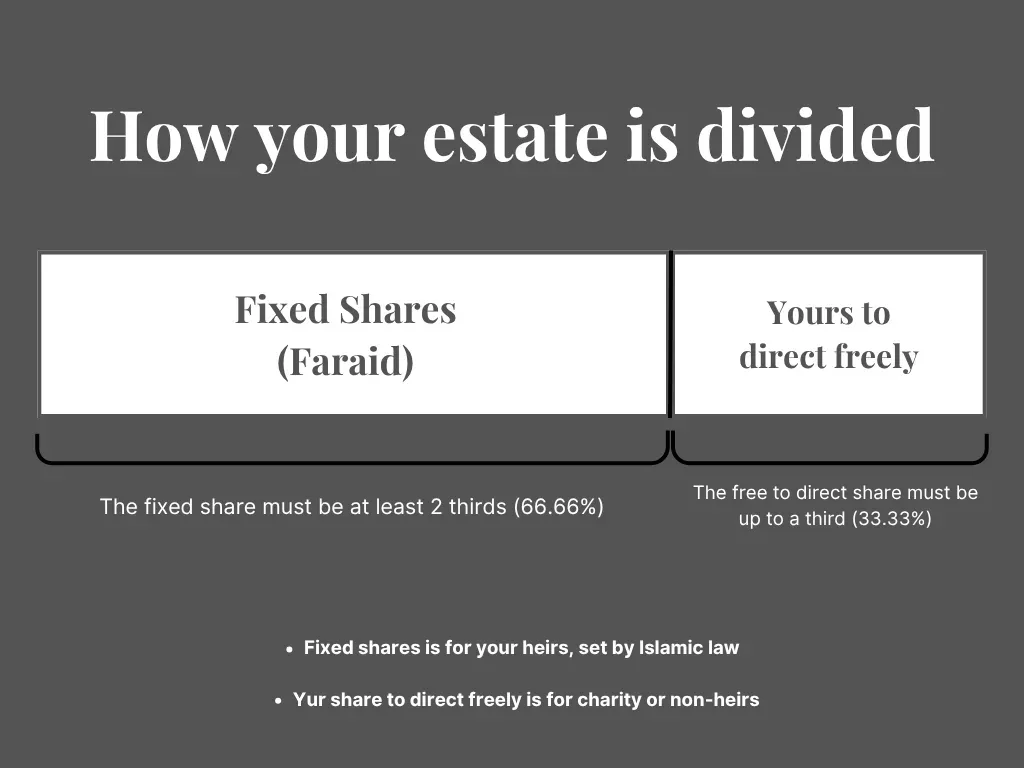
Islamic inheritance law divides your estate into two parts. Fixed shares (faraid) for your heirs govern at least two thirds of it, and up to one third is yours to direct freely.
The fixed shares give defined portions to close family such as your spouse, children and parents, and in some situations to wider relatives. What each person receives depends on who survives you and on your own circumstances, so the shares are worked out for your specific family rather than applied as a single standard formula.
Two points follow from this. The shares depend on who survives you, not on your family as it stands today. And a will we draft is built to reflect those changes, so we recommend reviewing it after any birth, death or marriage in the family.
Up to one third of your estate can be left by bequest to people who are not fixed-share heirs, or to charity. Many clients use it for grandchildren, for relatives in need or as sadaqah jariyah, an ongoing charitable gift in their name.
Gifts to UK registered charities are also free of inheritance tax, which makes this third a genuinely efficient way to give. More on tax below.
What happens if a Muslim dies without a will in England and Wales?
When someone dies without a valid will, the intestacy rules decide who inherits, in a fixed legal order. Those rules were not written with Islamic principles in mind, and they do not follow them.
Under intestacy, a surviving spouse may take the whole estate, but only where there are no surviving children. Where children do survive, the estate is split by a statutory formula that may bear no resemblance to the shares your faith sets out. Either way, the outcome is decided by statute, not by your faith.
There is a harder edge to this. If you were married by nikah only (Islamic marriage) and the marriage was never registered under English civil law, your spouse has no automatic right to inherit under intestacy at all. However long you have been together, the law treats an unregistered religious marriage like no marriage, and unmarried partners inherit nothing under the intestacy rules. A valid will is the only reliable way to provide for them.
Sorting out an estate after a death is work our probate and estate administration team handles every week, and we see the difference a clear will makes to a grieving family
The joint property trap most families miss
Here is the issue we find most often when reviewing a family's affairs, and almost no one has been warned about it.
If you and your spouse own your home as joint tenants, the survivor automatically owns the whole property the moment one of you dies. The home does not form part of the estate, so it passes outside your will and outside the Sharia shares entirely, no matter how carefully the will was drafted.
The fix is straightforward. The ownership can be changed to tenants in common, which means each of you owns a distinct share that passes under your will. This change, called severing the joint tenancy, is a short formal step we can deal with alongside your will.
Property is not the only asset that can bypass a will. Pensions, death in service benefits and life policies written in trust usually pass under the nomination forms you signed with the provider, not under your will. When we prepare your Islamic will we review these nominations with you, so everything you own points in the same direction as your faith.
Islamic wills and inheritance tax
Inheritance tax is charged at 40% on the part of an estate above the nil rate band, currently £325,000 per person. An extra residence nil rate band of up to £175,000 can apply when a main home passes to children or grandchildren. Anything left to a spouse or civil partner is exempt without limit.
That spousal exemption creates a tension worth understanding. A standard English will often leaves everything to the surviving spouse, so no tax falls due on the first death. An Islamic will, by contrast, passes fixed shares to children and parents on the first death, and those shares do not qualify for the spouse exemption. On larger estates that can mean tax arises earlier than it otherwise would.
There is good news on the other side of the ledger. Anything you leave to charity from your free third is exempt from inheritance tax, and if at least 10% of your net estate goes to charity the rate on the rest drops from 40% to 36%.
We should also be honest about one more pressure point. Under the Inheritance (Provision for Family and Dependants) Act 1975, a spouse or dependant who feels the will leaves them without reasonable financial provision can ask a court to adjust it. A widow left one eighth of a substantial estate might have such a claim. Careful drafting, including life interest trust arrangements that give a surviving spouse security while preserving capital for the heirs, can ease both the tax position and this risk. This page is general information, and the right structure genuinely depends on your family and your estate.
What else your Islamic will can cover
An Islamic will does more than divide your estate. Yours can also:
- Appoint guardians for your children under 18, so the people who raise them are the people you chose.
- Record your funeral and burial wishes, including burial according to Islamic rites and your wish to avoid a routine post-mortem where possible. A coroner can still require one in some circumstances, but a clear written wish helps your family act quickly.
- Include your declaration of faith, so the document reflects who you are as well as what you own.
- Direct payment of outstanding religious obligations from your estate before distribution, such as unpaid zakat, kaffarah or hajj badal for a pilgrimage you were unable to make
How we prepare your Islamic will
Making an Islamic will with Ash Hill Solicitors is a simple process, and most clients find it far easier than they expected.
- A free 20-minute chat. You tell us about your family and what matters to you. We explain what an Islamic will involves and confirm the fixed fee before anything begins.
- A meeting, wherever suits you. At our Harrow office, or at your home, hospital or hospice if travelling is hard. Our team speaks English, Urdu, Punjabi and basic Arabic.
- Careful drafting: You decide how your estate should be shared, in line with the Sharia law. We put those wishes into a valid, properly drafted will, alongside your executors, guardians, funeral wishes and the portion you are free to direct.
- Signing and safekeeping. We oversee the signing so the witnessing is done properly, then advise on storing the will and when to review it.
Your will is prepared by the Ash Hill Solicitors team, who have over 10 years of experience.
Can I leave part of my estate to charity?
Yes. Up to one third of your estate can be left to charity or to anyone who is not a fixed-share heir. Charitable gifts are also free of inheritance tax, and larger gifts can reduce the tax rate on the rest of your estate.
Can my funeral wishes be included?
Yes. Your Islamic will can record your wish for burial according to Islamic rites, your preferred burial ground and your wish to avoid unnecessary delay or a routine post-mortem where possible.
Can I Change My Will Later?
You can change your will whenever you like for small changes or amendments as long as you still have the mental capacity to do so. We might recommend a full redrafting of your will if you want to make big changes.
Can I appoint guardians for my children?
Yes, and for parents of young children this is often the single most important clause. Your will names the people you trust to raise your children if both parents die while the children are under 18.
Can an Islamic will be challenged?
Any will can be challenged. The most relevant route is the Inheritance (Provision for Family and Dependants) Act 1975, under which a spouse or dependant can claim reasonable financial provision. Thoughtful drafting, and sometimes a life interest trust, reduces the risk of a successful claim.
Do I need a new will if my family changes?
Your will should be reviewed after any marriage, divorce, birth or death in the family, because the Sharia shares depend on who survives you. Marriage also automatically revokes an existing will under English law unless it was made in contemplation of that marriage.
We only had a nikah. Does my spouse inherit?
Not automatically. If your marriage was never registered under English civil law, your spouse has no right to inherit under the intestacy rules. A valid Islamic will is the way to make sure they are provided for.
How much does an Islamic will cost?